About 178 minutes
Interpreters — Edition Insights
Science Fiction Utopias
40,916 recorded words. 6 minutes difference from this book's estimate.
View Gutenberg source #32979
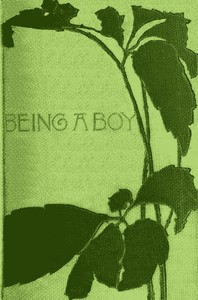
Being a Boy — Context and Discussion can be approached with a clearer sense of reading commitment from its source measurements: 39,425 words, 2 hr 52 min estimated reading time, and 20 detected text sections.
The text analysis averages about 26.2 words per sentence, while the detected sections provide another way to judge how the source is divided.
Project Gutenberg metadata also associates the work with “Autobiographies,” connecting these edition facts with the source record’s subject description.
Explore this collection
These alternatives are selected using recorded categories and estimated reading time.
About 178 minutes
Science Fiction Utopias
40,916 recorded words. 6 minutes difference from this book's estimate.
View Gutenberg source #32979About 157 minutes
Science Fiction Utopias
36,073 recorded words. 15 minutes difference from this book's estimate.
View Gutenberg source #43951About 189 minutes
Science Fiction Utopias
43,456 recorded words. 17 minutes difference from this book's estimate.
View Gutenberg source #34215Search stored excerpts and compare books → Choose by your preferences →
Choices use stored catalog measurements. Estimates vary with reading speed. A shared category is a catalog label, not a claim that two books have the same argument or literary quality.
Search reads excerpt text stored with this catalog and links to its associated Gutenberg record. The connection is stored in the site database; this tool does not recheck that every excerpt is word-for-word identical to that external record. Excerpt search does not cover every chapter and does not verify historical publication dates.
Catalog snapshot checked: 2026-09-26. Coverage: 91 public books, 91 available source excerpts.
Calculated from edition completeness, EPUB availability, text structure and catalogue metadata. Not a user rating.
Total of 100 points, scaled to a 2.5-5.0 range. Editions with an empty description or a missing EPUB file are not scored.
Public-domain source text
The source text is kept in the dedicated reader, separate from this catalogue record and its commentary.
Charles Dudley Warner's Being a Boy (1877) opens with a preface that situates its rural New England scenes between 1830 and 1850, a period he calls one of darkness before lucifer matches. The author's voice is immediately distinctive: wry, self-deprecating, and fond of understatement. He describes the volume's papers as wayward, a word that signals the loose, anecdotal structure to follow. Warner does not claim exhaustive autobiography; instead, he offers a series of vignettes built around a generic boy—often called John—whose experiences are rendered with a blend of nostalgia and ironic distance.
Warner's word choices ground the narrative in tangible, often homely details. In the preface, he lists possible fates for the boys described: they might have become selectmen, sheriffs, or gone to Congress, or they might have plodded along on a farm, cultivating rheumatism. The verb cultivating is deliberately mismatched with rheumatism, creating a dry humor that undercuts any sentimental view of farm life. Similarly, he describes the weather as having all the fascination and all the power of being disagreeable belonging to the most accomplished coquette. The simile is unexpected—weather as a flirtatious woman—and it reveals Warner's tendency to animate the natural world with human caprice. These choices avoid generic pastoral language; they insist on the particular, often irritating, texture of lived experience.
Warner renders John's consciousness through a mix of free indirect discourse and precise external description. When John receives an invitation to Cynthia Rudd's party, the narrator notes that the billet was sealed with a transparent wafer and written in blue ink, the finest kind of pin-scratching writing. The detail of the wafer—a thin, adhesive disk—is period-specific and visually exact. John's reaction is conveyed through his repeated reading and his confidential showing to a favorite cousin. The narrator adds that the billet exhaled a faint perfume, whether of lavender or caraway-seed he could not tell. This uncertainty is telling: it marks John's inexperience and his inability to decode the social signals of girlhood. Warner does not mock this confusion; he presents it as a genuine, almost scientific, puzzle.
The chapter 'John's First Party' exemplifies Warner's structural cunning. The title promises an event, but John does not attend: he breaks through ice while skating and is pulled out by another boy. The party is deferred, and the narrative shifts to a later party at Deacon Mayhew's. This anticlimax is deliberate. Warner uses the missed party to explore John's physical world—the river, the ice, the rescue—and then uses the second party to examine social anxiety. At the Mayhew house, John hesitates at the front door, hearing girls' voices that set his heart in a flutter. The narrator compares the girl's natural ease in society to a duckling taking to a pond, while the boy plunges in with a great splash, hiding shyness in noise. The simile is extended and precise, and it structures the entire scene around a contrast between gendered social performances.
Warner repeatedly contrasts the constrained indoor world of adults with the free outdoor world of boys. The parlor at Deacon Mayhew's is described as awful, a carpeted room of haircloth furniture, seldom opened. On the wall hang two certificates framed in black, one certifying that by payment of fifty dollars the deacon was a life member of the American Tract Society. The detail is both specific and satirical: the certificates are markers of piety and respectability, but they are also objects of display, as deadening as the haircloth. Outside, the boy's realm is one of skating, fishing, and treeing woodchucks. Warner does not idealize the outdoors; he notes its dangers (the broken ice) and its discomforts (the surly dog). But the energy of the prose always quickens when the boy moves out of doors. The parlor scenes are static, filled with constraint; the outdoor scenes are kinetic, filled with risk and movement.
Readers approaching Being a Boy should attend to Warner's tonal shifts: he moves from dry humor to genuine pathos without warning. The book rewards attention to its small, concrete details—the transparent wafer, the haircloth furniture, the caraway-seed scent—because these are the evidence of a writer who believed that truth resides in the particular. The preface warns that the papers are wayward, and they are. But their waywardness is a method, not a flaw.
Reading the editorial notes on Being a Boy, I kept thinking how Warner's precise, ironic little observations feel like a particular kind of time-capsule—not just the scenes, but the texture of the mind behind them. That same careful, almost fussy attention to the imperfections of a text reminded me of the Animaduersions uppon the annotacions and corrections of some imperfections of impressiones of Chaucer's workes 1865 edition — Text and Context, where even the printed errors feel like a living hand pointing at them, gently.
Your answers remain private and are stored only in this browser.