Animaduersions uppon the annotacions and corrections of some imperfections of impressiones of Chaucer's workes 1865 edition — Text and Context

(0 User reviews)   29
Thynne, Francis, 1545?-1608, Kingsley, G. H. (George Henry), 1827-1892 [Editor] Project Gutenberg 2009 Not confirmed
Chaucer, Geoffrey, -1400 -- Criticism, Textual; Speght, Thomas, -1621; Thynne, William, -1546 Readers of public-domain and historical texts
Project Gutenberg digital edition en

Edition facts

Words 28,545
Reading time 125 min
Text sections 6

Before opening Animaduersions uppon the annotacions and corrections of some imperfections of impressiones of Chaucer's workes 1865 edition — Text and Context, the edition data offers a quick orientation: 28,545 words, 2 hr 5 min estimated reading time, and 6 detected text sections.

The text analysis averages about 29.6 words per sentence, while the detected sections provide another way to judge how the source is divided.

Project Gutenberg metadata also associates the work with “Chaucer, Geoffrey, -1400 -- Criticism, Textual,” connecting these edition facts with the source record’s subject description.

Francis Thynne's 1598 manuscript, edited by G. H. Kingsley in 1865, offers a meticulous critique of Thomas Speght's Chaucer annotations. Thynne dissects word meanings, hawk types, and alchemical terms, revealing a 16th-century editor's rigorous philological method and his combative yet learned tone.
Share
Editorial Edition Score 4.6/5

Calculated from edition completeness, EPUB availability, text structure and catalogue metadata. Not a user rating.

How this score is calculated
  • Description quality20 pts
  • Title & short description10 pts
  • Source metadata20 pts
  • Text length15 pts
  • Chapters / structure15 pts
  • EPUB file integrity20 pts

Total of 100 points, scaled to a 2.5-5.0 range. Editions with an empty description or a missing EPUB file are not scored.

Edition quality

Read the Text

The clergy offended that the temporal men were found as wise as themselves. A merchant by Attorney is no true merchant. Alice, the wife of Richard Neville, was daughter of Thomas Montacute. He correcteth Master Speight his dates and history of printing. The Romante of the Rose began by Guillm̄ de Loris, and finished by John de la Meune. Why the dream of Chaucer cannot be the book of the Duchess. John of Gaunt, his incontinency. Doubteth master Speight’s ability in the exposition of old words, but commendeth his diligence and knowledge. Aketon or Slevelesse jacket of plate for the war. A besant is a besant, and not a duckett. Fermentacione is fermentacione, and not dawbing even metaphorically. Orfrayes not Goldsmith’s work, but frysed cloth of gold, a manufacture peculiar to the English. Oundye and Crispe meaneth wavy like water. Resager is ratsbane or arsenic. Begyns are nuns, though it cometh to mean superstitious and hypocritical women from their nature. Citrinatione or perfect digestion. Forage is old and hard provision made for horses and cattle in winter, or metaphorically, or to help out the ryme it may mean grass. Heroner is a long-winged hawk for the heron. The Hyppe is the berye of the sweet bryer or eglantine. Nowell meaneth more than Christmas. Porpherye is a peculiar marble, not marble in common. Sendale, a sylke stuffe. The trepegett is not the battering-ram, but an engine to cast stones. Wiuer or Wyvern, a serpent like unto a dragon. Autenticke meaneth a thing of auctoritye, not of antiquitye. Abandone is not liberty though Hollyband sayeth so. Of the Vernacle. Master Thynne would read Campaneus for Capaneus, and giveth reasons. Liketh the reading of Eros, but preferreth that of Heros, and giveth reasons. Of florins and their name from the Florentines. Sterling money taketh its name from the Esterlings. King John of France, his ransom of three millions of florens. Of the oken garland of Emelye. Eyther for euerye, an overnice correction. The intellect of Arcite had not wholly gone, or he would not have known Emelye. Straught, a better word than haughte. Visage for vassalage, an impertinent correction. Leefe for lothe, a nedeless correction. It is more likely that Absolon knocked than that he coughed at the window. Surrye or Russye, indifferent which. Cambuscan is Caius canne. “That may not saye naye,” better than “there may no wighte say naye.” Theophraste, not Paraphraste. The wife of Bath’s Prologue taken from the author of Policraticon. Country, not Couentry. Maketh, not waketh. Hugh of Lincoln. “Where the sunne is in his ascensione,” a good reading. Kenelm slain by Queen Drida. Master Speight mistaketh his almanack. The degrees of the signe are misreckoned, not the signe itself. Mereturicke is a corruption of Merecenrycke, or the kingdom of Mercia. Pilloures of silver borne before Cardinalls. Liketh best the old reading of “change of many manner of meates.” And also the old reading of “myters” more than one or two for the sake of the meter. The lordes sonne of Windsore is in the French Romant of the rose, but is there spelled Guindesores. Master Thynne knoweth not clearly why the Baron should be called of Windsor. The ordeal was not tryall by fier only, but also by water, nor for chastity only, but for many other matters. The fyery ordeal was by going on hote shares and cultors, not going through the fyre. The mother of Edward confessor passed over nine burnynge shares. The ordeal taken away by the court of Rome, and after by Henry III. The stork bewrayeth not adultery but wreaketh the adultery of his owne mate. The plowman’s tale is wrong placed. Chaucer’s proper works should be distinguished from those adulterat and not his. There were three editions of Chaucer before William Thynne dedicated his to Henry VIII. The first editions being very corrupt, William Thynne augmented and corrected them. Master Speight hath omytted many auctors vouched by Chaucer. It should be Harlottes, and not Haroldes. The king of Ribalds or Harlottes, an officer of great accompt in times past. Johannes Tyllius maketh mention of a Rex Ribaldorum. Also Vincentius Luparius maketh him an honourable officer. The Rex Ribaldorum was like unto our Marshall. The Marshalls duties and his powers over Harlotts and lost men. Master Thynne being a herold liketh not that false semblance should be thought one. Hate was a Moueresse or stirrer of debate, not a minoresse. Molinet calleth Hate a Ducteress, or leader.]

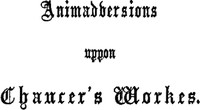
uppon the Annotacions and correct{i}ons of some imperfect{i}ons of impress{i}ones of Chaucer’s workes (sett downe before tyme and nowe) reprinted in the yere of our lorde 1598

Sett downe by FRANCIS THYNNE.

“Sortee pur bien ou ne sortee rien.”

Francis Thynne's Animaduersions uppon the annotacions and corrections of some imperfections of impressiones of Chaucer's workes, here edited from the Bridgewater Library manuscript by G. H. Kingsley for the Early English Text Society in 1865, is a sustained, point-by-point rebuttal of Thomas Speght's 1598 edition of Chaucer. Thynne writes as a seasoned antiquary, his voice alternating between patient explanation and sharp correction. The work is less a reading guide than a forensic examination of lexical and textual errors, grounded in a deep familiarity with Chaucer's language and the natural world of hawking, alchemy, and rural life.

A Philologist at Work: Thynne’s Method of Correction

Thynne’s primary tool is the precise definition of words. He does not merely assert that Speght is wrong; he demonstrates why, often by tracing a word’s Latin root or its use in other Chaucerian passages. For instance, he challenges Speght’s gloss of “forage” as simply “meat” or “fodder,” insisting that in the Reeve’s Prologue it means specifically “hard and old provision made for horses and cattle in winter.” He supports this by quoting the line “my fodder is forage” and arguing that “fodder” is a general term for animal feed, while “forage” denotes a particular kind. Thynne even allows that Chaucer may have used the word metaphorically or for rhyme in Sir Thopas, but he maintains that the proper sense is the one grounded in Latin forragium. This method—citing etymology, context, and authorial usage—recurs throughout the Animaduersions, giving the text a systematic, almost legalistic character.

The Language of Expertise: Hawks, Berries, and Alchemy

Thynne’s corrections often draw on specialized knowledge. In his entry on “heroner,” he explains that this is not merely a kind of hawk but a particularly valued long-winged hawk used for hunting herons, because the heron’s defensive flight—turning belly-up and excreting or striking with its bill—makes the chase dangerous. Similarly, he corrects Speght’s definition of “hyppe” as simply the red berry of the briar, insisting it must be the berry of the sweet briar or eglantine, to distinguish it from the common bramble’s blackberry, which is red only when unripe. In alchemical passages, Thynne cites Arnold of Villanova on “citrination” as the sign of perfect digestion in the philosopher’s stone, comparing it to the color of urine after rest. These examples show Thynne as a polymath, comfortable moving between falconry, botany, and alchemical theory to refine Chaucer’s text.

Tone and Pace: From Patient Explanation to Sharp Rebuke

The Animaduersions is not a dry list of errata; it has a distinct rhetorical rhythm. Thynne often begins a correction with a calm, almost pedagogical tone, as when he explains the etymology of “Nowell” as “God with us” rather than simply “Christmas.” But he can shift to pointed sarcasm, as when he dismisses Speght’s gloss on “hyppe” by noting that “the blacke berye ys also redde for a tyme, and then may be called the redde Berye of the Bryer for that tyme”—a logical trap that exposes the inadequacy of Speght’s definition. This alternation between instruction and rebuke gives the prose a dynamic quality, reflecting Thynne’s dual role as scholar and polemicist. The pace varies accordingly: leisurely when explaining, brisk when refuting.

Readers approaching this edition should be prepared for a dense, argumentative text that rewards close attention. Kingsley’s editorial apparatus—including notes on textual variants and a preface tracing the Thynne family—provides essential context. The Animaduersions is best read alongside a copy of Speght’s Chaucer and, ideally, a modern edition of Chaucer’s works, so that Thynne’s corrections can be weighed against the original lines he cites. It offers a rare window into the practices and passions of early modern textual criticism.

Some afternoons I think of Francis Thynne, scratching his corrections in ink, convinced every word mattered—and I remember another old friend, Sketches and Studies — Context and Discussion, which holds the same patient affection for what others overlook. Both know that loving a text is mostly a quiet, stubborn attention.

There are no reviews for this eBook.

0
0 out of 5 (0 User reviews )

Add a Review

Your Rating *
There are no comments for this eBook.

Reader reflection

Your personal reading reflection

Build a private reading journal entry for this title.

Your progress 0 / 10
1

Where are you in your reading?

2

How much did you enjoy the reading experience?

3

Would you recommend this book to another reader?

4

Did the language feel accessible?

Related eBooks