About 482 minutes
Among My Books. Second Series — A Closer Reading
Fantasy Juvenile Worlds
110,680 recorded words. 28 minutes difference from this book's estimate.
View Gutenberg source #8509
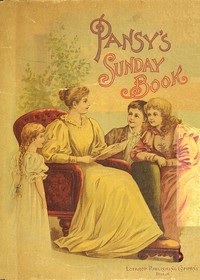
The catalog record for Pansy's Sunday Book — Reading Notes provides practical reading context through 117,146 words, 8 hr 30 min estimated reading time, and 18 detected text sections.
The text analysis averages about 18.8 words per sentence, while the detected sections provide another way to judge how the source is divided.
Project Gutenberg metadata also associates the work with “Children's poetry,” connecting these edition facts with the source record’s subject description.
Explore this collection
These alternatives are selected using recorded categories and estimated reading time.
About 482 minutes
Fantasy Juvenile Worlds
110,680 recorded words. 28 minutes difference from this book's estimate.
View Gutenberg source #8509About 444 minutes
Fantasy Juvenile Worlds
101,963 recorded words. 66 minutes difference from this book's estimate.
View Gutenberg source #43601About 395 minutes
Fantasy Juvenile Worlds
90,686 recorded words. 115 minutes difference from this book's estimate.
View Gutenberg source #33896Search stored excerpts and compare books → Choose by your preferences →
Choices use stored catalog measurements. Estimates vary with reading speed. A shared category is a catalog label, not a claim that two books have the same argument or literary quality.
Search reads excerpt text stored with this catalog and links to its associated Gutenberg record. The connection is stored in the site database; this tool does not recheck that every excerpt is word-for-word identical to that external record. Excerpt search does not cover every chapter and does not verify historical publication dates.
Catalog snapshot checked: 2026-09-26. Coverage: 91 public books, 91 available source excerpts.
Calculated from edition completeness, EPUB availability, text structure and catalogue metadata. Not a user rating.
Total of 100 points, scaled to a 2.5-5.0 range. Editions with an empty description or a missing EPUB file are not scored.
Public-domain source text
The source text is kept in the dedicated reader, separate from this catalogue record and its commentary.
Pansy's Sunday Book opens with a poem that immediately establishes a direct, intimate address to the child reader: “If you’ll sit on my knee / As still as a stone.” The speaker’s voice is both gentle and commanding, using simple rhyme and meter to draw the listener into a moral tale about a poor boy named Tommy Tinker. This choice of a conversational, almost nursery-rhyme tone contrasts sharply with the later sections, which include letters written by children themselves, full of specific, unadorned observations about New York City landmarks. The editor, Pansy, assembles a collection that moves between didactic verse, sentimental narrative, and what appears to be authentic juvenile prose, creating a layered reading experience that rewards attention to shifts in register and perspective.
The collection’s diction varies markedly between the adult-authored pieces and the children’s letters. In the opening poem, the language is deliberately simple and rhythmic, with words like “slattern” and “bereft” sitting alongside colloquial phrases such as “you may think, to behold.” This mix suggests an adult writer adjusting vocabulary for a young audience while retaining some literary flair. By contrast, the letters attributed to children—such as Emmeline Andrews’s account of the reading room—use plain, concrete language: “rows and rows and rows of books,” “a check made of brass, or tin, or something.” The repetition and hedging (“or something”) mimic a child’s imprecise but earnest reporting. The editor likely preserved these idiosyncrasies to convey authenticity, letting the young correspondents’ voices stand in their own right.
Dialogue in the collection often serves a pedagogical function. In the poem, the speaker directly addresses the child listener, using imperatives (“May you love this, my lad”) and rhetorical questions (“So say you?”) to guide moral response. The letters, however, include reported conversations that reveal character through argument. For instance, Dick Walters insists he has been inside a church built in 1697, only to be corrected by the professor and later by the letter-writer’s own research. This exchange models how factual disputes can be resolved through inquiry—a subtle lesson in intellectual humility. The dialogue is not merely decorative; it demonstrates how children learn from both authority figures and peers, and how the collection itself encourages careful observation over stubborn opinion.
Descriptions of place in the children’s letters are notably precise, focusing on measurable details rather than emotional impressions. Laura J. Westover’s account of Central Park includes specific gate names (“Scholars’ Gate”), the location of the menagerie, and the Bethesda Fountain with its “real angel—well, I mean a carved one.” Another letter about the Obelisk provides dimensions (“sixty-nine feet high”) and the logistical feat of its transport (“thirty-two horses to draw just the pedestal”). These details ground the narrative in a recognizable, factual world. The editor’s choice to include such data suggests a preference for instructive realism over pure fantasy, aligning with the book’s stated aim to teach conduct of life through concrete examples rather than abstract moralizing.
The book’s structure alternates between verse, prose narrative, and epistolary sections, each with distinct formal features. The opening poem uses a regular meter and rhyme scheme (ABAB) to create a lulling, memorable cadence. The letters, by contrast, are written in straightforward prose with paragraph breaks and occasional dialogue. This variety prevents monotony and invites the reader to shift modes of attention. The editor also includes illustrations (referenced in the text, e.g., “His picture”) that likely reinforce key moments. By juxtaposing a sentimental tale of a poor boy with factual reports from children about their urban explorations, Pansy creates a dialogue between imagination and observation, encouraging the young reader to see both as valid ways of understanding the world.
Readers approaching Pansy’s Sunday Book will find it useful to attend to who is speaking and in what form. The adult-authored pieces often carry explicit moral lessons, while the children’s letters reward careful reading for their unvarnished detail and occasional humor. The collection does not present a single narrative but a mosaic of voices, each with its own diction and purpose. Noticing these shifts—from the poem’s rhythmic intimacy to the letters’ plain reportage—can deepen appreciation of the editor’s craft in shaping a Sunday book that is both instructive and varied.
There’s something tender about how Pansy’s Sunday Book lets its children speak in their own uneven voices, awkward and true. It reminded me of the strange, quiet honesty I found in The Life and Writings of Henry Fuseli, Volume 2 (of 3) — Story, Setting & Ideas — that same willingness to let personality sit beside instruction, unpolished, still breathing. I miss that kind of patience in books.
Answer a few questions and save a private reflection on this device.