About 67 minutes
An apology for the study of northern antiquities — Inside the Classic
Science Fiction Utopias
15,339 recorded words. 0 minutes difference from this book's estimate.
View Gutenberg source #15329
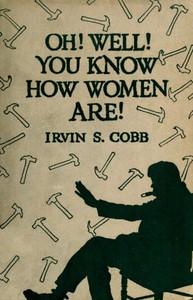
This digital edition of 'Oh, Well, You Know How Women Are!' — Themes and Context is described by source-level measurements including 15,204 words, 1 hr 7 min estimated reading time, and 2 detected text sections.
The text analysis averages about 19.6 words per sentence, while the detected sections provide another way to judge how the source is divided.
Project Gutenberg metadata also associates the work with “Sex differences -- Humor,” connecting these edition facts with the source record’s subject description.
Explore this collection
These alternatives are selected using recorded categories and estimated reading time.
About 67 minutes
Science Fiction Utopias
15,339 recorded words. 0 minutes difference from this book's estimate.
View Gutenberg source #15329About 49 minutes
Science Fiction Utopias
11,226 recorded words. 18 minutes difference from this book's estimate.
View Gutenberg source #37699About 31 minutes
Science Fiction Utopias
7,114 recorded words. 36 minutes difference from this book's estimate.
View Gutenberg source #52465Search stored excerpts and compare books → Choose by your preferences →
Choices use stored catalog measurements. Estimates vary with reading speed. A shared category is a catalog label, not a claim that two books have the same argument or literary quality.
Search reads excerpt text stored with this catalog and links to its associated Gutenberg record. The connection is stored in the site database; this tool does not recheck that every excerpt is word-for-word identical to that external record. Excerpt search does not cover every chapter and does not verify historical publication dates.
Catalog snapshot checked: 2026-09-26. Coverage: 91 public books, 91 available source excerpts.
Calculated from edition completeness, EPUB availability, text structure and catalogue metadata. Not a user rating.
Total of 100 points, scaled to a 2.5-5.0 range. Editions with an empty description or a missing EPUB file are not scored.
Public-domain source text
The source text is kept in the dedicated reader, separate from this catalogue record and its commentary.
The book opens with Irvin S. Cobb's essay 'Oh, Well, You Know How Women Are!' which immediately establishes a mock-anthropological tone. The first excerpt describes a woman emerging from a shop and stopping to talk with an acquaintance, blocking traffic. Cobb's narrator claims women's cordiality is inversely proportional to their dislike, and that they 'take root' in doorways, causing confusion. This sets up a pattern of humorous generalization based on observed behavior, with the narrator professing ignorance of deeper causes.
The opening scene is carefully staged: 'She emerges from the shop. She is any woman, and the shop from which she emerges is any shop in any town.' This universalizing move is typical of the essay's method. Cobb contrasts women's behavior with what men would do—'Two men meeting under the same condition would mechanically draw away a few paces'—and then escalates the scenario to absurd extremes: a fire escape, the Pearly Gates. The humor relies on the reader's recognition of the type, not on individual character. The narrator's voice is confiding and slightly exasperated, as if sharing a private observation.
In the middle excerpt, Mary Roberts Rinehart takes over with 'Isn't That Just Like a Man!' She inverts the cat-dog comparison: women are like dogs—'They love like dogs, a little insistently'—while men are like cats, with their 'love for old, familiar things.' She introduces a man with many bedroom slippers who wears only the old red knitted ones. The section builds to a claim about male solidarity: 'They stand together against the rest of the world. Women do not.' This is framed as a 'trades union' and 'mutual benefit society' with its own Golden Rule. The tone is playful but pointed, using analogy to argue for fundamental differences.
Both authors employ a similar rhetorical strategy: they present a specific, often trivial behavior, then inflate it into a universal law. Cobb's narrator cannot explain why women block doorways—'It is not given for us to know'—while Rinehart traces male loyalty to 'a survival from the days when men united for defense.' The humor depends on the gap between the mundane example and the grand explanation. Readers should note how each author uses hypotheticals ('if the meeting took place...') and direct address ('you know what I mean') to create intimacy. The essays are structured as a series of such observations, linked by a mock-serious thesis.
The book is a diptych: two essays, each about 7,600 words, responding to each other. Cobb's essay appears first, then Rinehart's. The excerpts show that Rinehart directly engages Cobb's claims—for instance, she corrects his cat-dog analogy: 'Really, the only resemblance between men and dogs is that they both rather run to feet in early life.' This back-and-forth creates a dialogue, though the reader only hears one voice at a time. The structure invites comparison: both authors use the same template of humorous generalization, but with different targets. The book's title, with its ironic quotation marks, signals that these are performances of stereotype, not earnest sociology.
Reading these excerpts sequentially reveals how the two essays mirror and mock each other. Pay attention to the recurring motifs—shopping, clothing, social rituals—and how each author reinterprets them. The humor is period-specific but the rhetorical moves are durable. The book rewards a reading that treats each essay as a crafted monologue, not a transparent argument.
That old 1920s book made me chuckle at how little we change, but it also left a quiet ache—all that posturing as armor. I keep thinking about how exhaustion hides behind our routines. There’s a gentler companion to that feeling in Fat and Blood An Essay on the Treatment of Certain Forms of Neurasthenia and Hysteria — Edition Insights, which treats our frailty as something worth tending, not mocking. It lingered like a hand on a shoulder.
Capture what you thought, learned, and would like to remember.