About 395 minutes
Dante. An essay. To which is added a translation of De Monarchia. — Edition Insights
Fantasy Juvenile Worlds
90,686 recorded words. 12 minutes difference from this book's estimate.
View Gutenberg source #33896
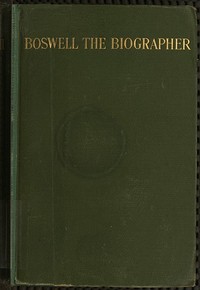
This digital edition of Boswell the Biographer — Themes and Context is described by source-level measurements including 87,952 words, 6 hr 23 min estimated reading time, and 22 detected text sections.
The text analysis averages about 22.8 words per sentence, while the detected sections provide another way to judge how the source is divided.
Project Gutenberg metadata also associates the work with “Boswell, James, 1740-1795,” connecting these edition facts with the source record’s subject description.
Explore this collection
These alternatives are selected using recorded categories and estimated reading time.
About 395 minutes
Fantasy Juvenile Worlds
90,686 recorded words. 12 minutes difference from this book's estimate.
View Gutenberg source #33896About 369 minutes
Fantasy Juvenile Worlds
84,778 recorded words. 14 minutes difference from this book's estimate.
View Gutenberg source #11068About 326 minutes
Fantasy Juvenile Worlds
74,935 recorded words. 57 minutes difference from this book's estimate.
View Gutenberg source #39890Search stored excerpts and compare books → Choose by your preferences →
Choices use stored catalog measurements. Estimates vary with reading speed. A shared category is a catalog label, not a claim that two books have the same argument or literary quality.
Search reads excerpt text stored with this catalog and links to its associated Gutenberg record. The connection is stored in the site database; this tool does not recheck that every excerpt is word-for-word identical to that external record. Excerpt search does not cover every chapter and does not verify historical publication dates.
Catalog snapshot checked: 2026-09-26. Coverage: 91 public books, 91 available source excerpts.
Calculated from edition completeness, EPUB availability, text structure and catalogue metadata. Not a user rating.
Total of 100 points, scaled to a 2.5-5.0 range. Editions with an empty description or a missing EPUB file are not scored.
Public-domain source text
The source text is kept in the dedicated reader, separate from this catalogue record and its commentary.
George Mallory's Boswell the Biographer (1912) opens with an unusual confession: the author apologizes for writing a book that is 'less than a biography and more than an essay.' Rather than a complete life, Mallory aims to 'explain' Boswell's character by presenting evidence 'without stint.' The preface signals a methodical, almost legalistic approach—Mallory wants to prove his case, not merely state opinions. This forensic tone shapes the entire work, as the author scrutinizes Boswell's letters, political maneuvers, and social climbing with a biographer's eye for detail.
Mallory's preface is a remarkable piece of self-deprecation. He calls the responsibility of 'upwards of 300 pages in print' a burden his 'unaccustomed conscience cannot easily bear.' He refuses to apologize for a dull book by explaining how it is interesting—a rhetorical move that paradoxically draws attention to his anxiety. The preface establishes Mallory as a careful scholar who anticipates criticism. He acknowledges debts to earlier biographers (Rogers, Fitzgerald, Leask) and to critics like Carlyle, Henley, and Lionel Johnson. This scholarly apparatus, combined with the apologetic tone, suggests Mallory is acutely aware of entering a crowded field. The reader is warned: this is not a conventional biography but a character study built on evidence.
Mallory devotes considerable space to Boswell's relentless pursuit of patrons. He lists a litany of names—Lord Somerville, Sir David Dalrymple, Lord Eglintoun, Lord Mount Stuart, Sir Andrew Mitchell, Lord Pembroke, Lord Lisburne, Lord Lonsdale, Burke, Dundas—and notes that Boswell 'pinned his faith' on each in turn. The result was meager: only the Recordership of Carlisle. Mallory quotes Boswell's own letters to illustrate his methods, including a cringe-worthy note to Chatham and a later attempt to ingratiate himself with Burke. The author's analysis is blunt: Boswell was a 'thorough-going place-hunter,' and his failures stemmed partly from his clumsy approach. Mallory uses Boswell's own words—'conspicuousness'—to highlight the man's self-awareness and naivety.
Boswell's political schemes, Mallory shows, produced some of his most interesting writings. His 'Letters to the People of Scotland' (1783 and 1785) displayed 'ardent patriotism and zealous Tory principles.' He also issued an 'Address to the Real Freeholders of the County of Ayr' and carried addresses to the King and the Prince of Wales. Mallory traces these efforts with a mix of admiration and irony: Boswell's political career was a failure, but the pamphlets and letters survive as evidence of his character. The author notes that Boswell's hopes of representing his county were 'very small,' yet he persisted. This section reveals how Mallory uses documentary evidence—letters, addresses, electioneering details—to build a portrait of a man driven by ambition but thwarted by circumstance.
Mallory's study is best approached as a character analysis rather than a narrative biography. Readers familiar with Boswell's Life of Johnson will find here a darker, more frustrated figure—a man whose literary genius coexisted with social failure. The author's method is cumulative: each letter, each failed patronage, each political misstep adds to a coherent psychological portrait. Mallory does not claim to have the final word, but his evidence-based approach offers a compelling counterpoint to hagiography.
Holding this book, I recalled afternoons spent tracing my own grandfather’s letters, the way he shaped his story for each recipient. Mallory’s patient unravelling of Boswell’s curious self-awareness felt familiar. It reminded me of reading The Praise of a Godly Woman — Edition Insights, where another life was quietly honoured through careful attention to context, not just deeds. Both left me understanding the craft behind the memory, oddly tender.
Build a private reading journal entry for this title.