Coaches and Coaching — Story, Setting & Ideas
Edition facts
The catalog record for Coaches and Coaching — Story, Setting & Ideas provides practical reading context through 13,353 words, 59 min estimated reading time, and 2 detected text sections.
The text analysis averages about 23.0 words per sentence, while the detected sections provide another way to judge how the source is divided.
Project Gutenberg metadata also associates the work with “Coaching (Transportation),” connecting these edition facts with the source record’s subject description.
Calculated from edition completeness, EPUB availability, text structure and catalogue metadata. Not a user rating.
How this score is calculated
- Description quality20 pts
- Title & short description10 pts
- Source metadata20 pts
- Text length15 pts
- Chapters / structure15 pts
- EPUB file integrity20 pts
Total of 100 points, scaled to a 2.5-5.0 range. Editions with an empty description or a missing EPUB file are not scored.
Read the Text
Men thought her Minerva, and him a new god. But why should I stories of Athens rehearse, Where people knew love, and were partial to verse? Since none can with justice my pleasures oppose, In Holland half drowned in interest and prose? By Greece and past ages what need I be tried, When the Hague and the present are both on my side? And is it enough for the joys of the day, To think what Anacreon or Sappho would say? When good Vandergoes, and his provident _vrow_, As they gaze on my triumph, do freely allow, That, search all the province, you'll find no man _dàr_ is So blest as the _Englishen Heer Secre ar'_ is."
If Prior had been living now he would have found the greatest want of travelling accommodation in a country for whose more serious wants we have to answer, without having her wit to help us to an excuse. There is a story told of an Irish post-chaise, the occupier of which, without quitting it, had to take to his heels. It was going down hill as fast as wind and the impossibility of stopping could make it, when the foot passengers observed a couple of legs underneath, emulating, with all their might, the rapidity of the wheels. The bottom had come out; and the gentleman was obliged to run for his life.
We must relate another anecdote of an Irish post-chaise, merely to show the natural tendencies of the people to be lawless in self-defence. A friend of ours, who was travelling among them, used to have this proposition put to him by the postillion whenever he approached a turnpike--"Plase your honour, will I drive at the pike?" The pike hung loosely across the road. Luckily, the rider happened to be of as lawless a turn for justice as the driver, so the answer was always a cordial one--"Oh yes--drive at the pike." The pike made way accordingly; and in a minute or two the gate people were heard and seen, screaming in vain after the illegal charioteers.
"Fertur equis auriga, neque audit currus." VIRGIL.
"The driver's borne beyond their swearing, And the post-chaise is hard of hearing."
As to following them, nobody in Ireland thinks of moving too much, legal or illegal.
The pleasure to be had in a mail-coach is not so much at one's command as that in a post-chaise. There is generally too little room in it, and too much hurry out of it. The company must not lounge over their breakfast, even if they are all agreed. It is an understood thing that they are to be uncomfortably punctual. They must get in at seven o'clock, though they are all going upon business they do not like or care about, or will have to wait till nine before they can do anything. Some persons know how to manage this haste, and breakfast and dine in the cracking of a whip. They stick with their fork, they joint, they sliver, they bolt. Legs and wings vanish before them like a dragon's before a knight-errant. But if one is not a clergyman or a regular jolly fellow, one has no chance this way. To be diffident or polite is fatal. It is a merit eagerly acknowledged, and as quickly set aside. At last you begin upon a leg, and are called off.
A very troublesome degree of science is necessary for being well settled in the coach. We remember travelling in our youth, upon the north road, with an orthodox elderly gentleman of venerable peruke, who talked much with a grave-looking young man about universities, and won our inexperienced heart with a notion that he was deep in Horace and Virgil. He was deeper in his wig.
Towards evening, as he seemed restless, we asked with much diffidence whether a change, even for the worse, might not relieve him; for we were riding backwards, and thought that all elderly people disliked that way. He insinuated the very objection; so we recoiled from asking him again.
In a minute or two, however, he insisted that we were uneasy ourselves, and that he must relieve us for our own sake. We protested as filially as possible against this; but at last, out of mere shame of disputing the point with so benevolent an elder, we changed seats with him.
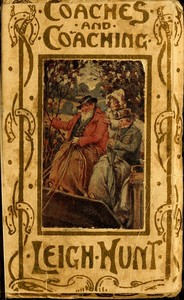
Leigh Hunt opens Coaches and Coaching by confessing a childhood fondness for hired coaches, from post-chaises to the despised hackney. He immediately establishes a hierarchy of vehicles: the private carriage rolls with “prouder ease,” full of cushions and elegance, while the stage coach and hackney are left behind. Hunt’s prose is tactile and kinetic—he describes the coachman’s “sounding lash,” the footman swinging on springy toes, and the carriage stopping with “lordly wilfulness.” Yet he undercuts this admiration, calling the private carriage “gouty and superfluous,” too exacting and exclusive. This opening sets up a tension between delight in luxury and a moral critique of its cost.
The Carriage’s Proud Anatomy
Hunt’s description of the private carriage is a study in controlled motion. He notes the horses “proud to draw it,” the fat coachman whose arm alone is in action, and the footman’s nonchalant swing. The vehicle itself is “full of cushions and comfort; elegantly coloured inside and out; rich, yet neat; light and rapid, yet substantial.” The paint flashes in the sun; the hammer-cloth trembles. Hunt even imagines the carriage recovering from a tilt with a jerk, “tossing and panting, as it were, for very breath, like the proud heads of the horses.” These details are not mere decoration—they build a portrait of a machine that mirrors its owner’s self-importance. The carriage’s every movement is theatrical, designed to project status. Yet Hunt’s own voice remains ambivalent: he calls the spectacle “very pretty” but immediately adds “it is also gouty and superfluous.”
The Hackney’s Human Heart
Midway through the excerpt, Hunt shifts focus to the hackney coach, a vehicle he personifies with surprising tenderness. He imagines its history: the poor taken to the workhouse, the wounded to hospital, lovers hastening in tears, and children carried to the grave. “Thou hast contained as many different passions in thee as a human heart,” he writes, addressing the coach directly. The hackney becomes “venerable” for its service, “as respectable as a reduced old gentleman, whose very slovenliness is pathetic.” This passage is the emotional core of the essay, where Hunt’s observational eye turns inward. He does not romanticize the coach’s shabbiness but finds dignity in its accumulated sorrows and joys. The tone is elegiac, almost devotional, a marked contrast to the earlier satire of private carriages.
The Hackney-Coachman’s Petty Tyranny
Hunt reserves his sharpest criticism for the hackney-coachman, whom he calls “the least agreeable specimen” of the driving species. The coachman’s faults are catalogued with a mixture of humor and irritation: he is “lying and cheating,” disputable over fares, and sets passengers against each other. Hunt describes how even a pleasant man can become “irritable” and “mercenary” when haggling over sixpence, and how a woman’s “rosy lips” grow pale over two-and-sixpence. The coachman’s whip is “malignant”; he hates boys who cut behind his coach, and he will “search the straw for you, and miss the half-crown on purpose.” This section is less about the vehicle than about human nature under economic pressure. Hunt’s tone is satirical but not cruel—he seems to understand that the coachman’s behavior is shaped by a life of petty struggle.
Shifting Tones and the Reader’s Path
What makes Coaches and Coaching distinctive is how Hunt moves between registers. The opening is playful and ornate, full of rhythmic sentences and theatrical imagery. The middle section turns solemn and personal, addressing the hackney as “thou” and investing it with pathos. The later passages return to satire, but with a sharper edge. This tonal variety is not random—it mirrors the social range of coaching itself, from the glittering carriage to the battered hackney. A first-time reader should attend to these shifts, as they reveal Hunt’s deeper argument: that vehicles are not just machines but repositories of human experience. The essay’s structure, moving from pride to pity to irritation, enacts the very emotions it describes. Hunt’s prose is the vehicle for this journey, and the reader is the passenger.
Hunt’s essay rewards attention to its physical details—the jerk of a carriage, the cut of a whip, the straw in a hackney’s floor. These are not decorative but functional, grounding his moral reflections in the material world. Read with an eye for how Hunt personifies vehicles and then undercuts that personification, and you will find a work that is both a period piece and a meditation on class, comfort, and the cost of convenience.
I found myself thinking of Leigh Hunt’s hackney coaches—their damp straw and worn velvet—and how he reads a life from a seat’s threadbare arm. The same quiet noticing of small, worn things lives in The Sunshade, the Glove, the Muff — Text and Context, where even a forgotten glove seems to hold a hand’s warmth still. Odd, how objects keep our moments.

There are no reviews for this eBook.
Your personal reading reflection
Build a private reading journal entry for this title.