About 243 minutes
Personal Reminiscences in Book Making, and Some Short Stories — Context and Discussion
Science Fiction Utopias
55,785 recorded words. 40 minutes difference from this book's estimate.
View Gutenberg source #21755
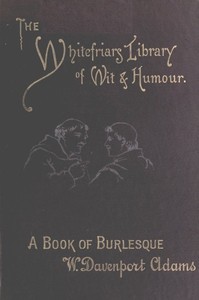
The source record for A Book of Burlesque: Sketches of English Stage Travestie and Parody — Reading Companion measures this digital text at 65,058 words, 4 hr 43 min estimated reading time, and 12 detected text sections.
The text analysis averages about 16.9 words per sentence, while the detected sections provide another way to judge how the source is divided.
Project Gutenberg metadata also associates the work with “English literature -- History and criticism,” connecting these edition facts with the source record’s subject description.
Explore this collection
These alternatives are selected using recorded categories and estimated reading time.
About 243 minutes
Science Fiction Utopias
55,785 recorded words. 40 minutes difference from this book's estimate.
View Gutenberg source #21755About 242 minutes
Science Fiction Utopias
55,634 recorded words. 41 minutes difference from this book's estimate.
View Gutenberg source #13298About 339 minutes
Science Fiction Utopias
77,935 recorded words. 56 minutes difference from this book's estimate.
View Gutenberg source #40474Search stored excerpts and compare books → Choose by your preferences →
Choices use stored catalog measurements. Estimates vary with reading speed. A shared category is a catalog label, not a claim that two books have the same argument or literary quality.
Search reads excerpt text stored with this catalog and links to its associated Gutenberg record. The connection is stored in the site database; this tool does not recheck that every excerpt is word-for-word identical to that external record. Excerpt search does not cover every chapter and does not verify historical publication dates.
Catalog snapshot checked: 2026-09-26. Coverage: 91 public books, 91 available source excerpts.
Calculated from edition completeness, EPUB availability, text structure and catalogue metadata. Not a user rating.
Total of 100 points, scaled to a 2.5-5.0 range. Editions with an empty description or a missing EPUB file are not scored.
Public-domain source text
The source text is kept in the dedicated reader, separate from this catalogue record and its commentary.
Adams opens by distinguishing his work from a comprehensive history, aiming instead to provide an introduction supplemented by sketches of burlesque groups and extracts that exhibit individual writers' methods. He emphasizes the literary side over the theatrical, though he includes dates and casts for reference. The preface explicitly excludes extravaganzas and bouffoneries musicales, confining the study to deliberate travesties of pre-existing subjects.
The book's structure reflects a taxonomic impulse: burlesques are grouped by their source material, with Shakespearean travesties receiving particular attention. Adams notes that while such pieces were not especially numerous, they stand out for their daring and the genuine fun exhibited by writers like Gilbert a'Beckett, Francis Talfourd, and W. S. Gilbert. He insists that burlesque, whether brilliant or bad, does no harm to the original—a claim he supports by quoting John Poole's defensive preface to his 1810 Hamlet Travestie.
Adams devotes considerable space to John Poole's Hamlet Travestie (1810), the first formal Shakespeare travesty. He quotes the opening dialogue, where King Claudius urges Hamlet to “cheer up” and proposes they “all get drunk together.” The soliloquies are turned into songs with refrains like “Derry down, down, down, derry down.” Adams judges the piece “dreary reading” despite its good intentions, noting that Poole made “all due apology for his temerity.” This early example sets a pattern: burlesques often retain the original plot but replace blank verse with doggerel, and characters speak in anachronistic slang. Adams uses Poole to illustrate the tension between reverence and ridicule that pervades the genre.
Adams argues that Shakespeare burlesquers were never “wholesale or intentionally irreverent.” He lists a lineage of writers—a'Beckett, Talfourd, Coyne, Brough, Halliday, Burnand, Byron, and Gilbert—who approached the Bard with a “genuine sense of fun.” The chapter traces how seventeenth- and eighteenth-century satirists left Shakespeare alone until Poole broke the taboo. Adams quotes Poole's ironic relief that, after three editions, Shakespeare was “neither expelled from our libraries, nor banished from our stage.” The section emphasizes the literary craft behind burlesque: the best examples, Adams implies, succeed by cleverly mimicking the original's structure while subverting its tone. He distinguishes these from mere “extravaganzas,” which he excludes from his study.
Adams repeatedly stresses the constraints of his project. He cannot supply a “consecutive and comprehensive history” within the allotted space. Instead, he offers sketches of groups into which burlesques “naturally fall,” with extracts to exhibit individual methods. He thanks living writers for access to their prompt books, allowing quotation from unpublished work. The preface makes clear that his focus is literary and humorous, not theatrical. This self-imposed limitation shapes the book's content: readers will find analysis of dialogue and structure rather than performance history. Adams's taxonomic approach—grouping burlesques by source—provides a framework for comparing how different writers treated similar material, from Shakespeare to contemporary dramas.
Adams's book is best approached as a curated anthology of examples rather than a narrative history. Readers interested in the mechanics of parody will find value in his extracts and his grouping of burlesques by source. The preface's frank acknowledgment of limitations—and its reliance on unpublished prompt books—gives the work a provisional, insider quality. Those seeking a broader cultural analysis of Victorian burlesque may need to supplement this volume with studies of the theatrical context Adams deliberately sets aside.
I think of A Book of Burlesque as a shelf where laughter echoes, heavy with masks and mock grandeur. It reminds me of the old tract on damnation, that other volume of thunderous tempests pretending to be certain. My hand wanders between them—the jest and the sermon—and finds a quiet kinship in the warmth of their shared, stubborn breath. Hell: Warm Words on the Cheerful and Comforting Doctrine of Eternal Damnation — Inside the Classic.
Save your reaction, strongest insight, and memorable passage.