About 273 minutes
In the Catskills: Selections from the Writings of John Burroughs — Themes and Context
Adventure Picaresque Fiction
62,646 recorded words. 7 minutes difference from this book's estimate.
View Gutenberg source #14108
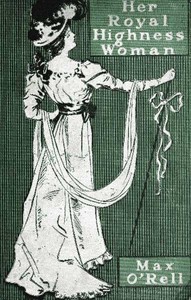
For Her Royal Highness Woman — Context and Discussion, the stored edition analysis reports 61,145 words, 4 hr 26 min estimated reading time, and 8 detected text sections.
The text analysis averages about 21.7 words per sentence, while the detected sections provide another way to judge how the source is divided.
Project Gutenberg metadata also associates the work with “Love,” connecting these edition facts with the source record’s subject description.
Explore this collection
These alternatives are selected using recorded categories and estimated reading time.
About 273 minutes
Adventure Picaresque Fiction
62,646 recorded words. 7 minutes difference from this book's estimate.
View Gutenberg source #14108About 259 minutes
Adventure Picaresque Fiction
59,567 recorded words. 7 minutes difference from this book's estimate.
View Gutenberg source #15698About 274 minutes
Adventure Picaresque Fiction
62,864 recorded words. 8 minutes difference from this book's estimate.
View Gutenberg source #19355Search stored excerpts and compare books → Choose by your preferences →
Choices use stored catalog measurements. Estimates vary with reading speed. A shared category is a catalog label, not a claim that two books have the same argument or literary quality.
Search reads excerpt text stored with this catalog and links to its associated Gutenberg record. The connection is stored in the site database; this tool does not recheck that every excerpt is word-for-word identical to that external record. Excerpt search does not cover every chapter and does not verify historical publication dates.
Catalog snapshot checked: 2026-09-26. Coverage: 91 public books, 91 available source excerpts.
Calculated from edition completeness, EPUB availability, text structure and catalogue metadata. Not a user rating.
Total of 100 points, scaled to a 2.5-5.0 range. Editions with an empty description or a missing EPUB file are not scored.
Public-domain source text
The source text is kept in the dedicated reader, separate from this catalogue record and its commentary.
Max O'Rell opens Her Royal Highness Woman with a characteristic blend of flattery and critique, addressing his subject as a 'queen' whose reign is both celebrated and questioned. The book's tone is set early: O'Rell adopts the persona of a worldly, amused observer, mixing gallantry with gentle satire. His prose moves between direct address to the reader and illustrative anecdotes, such as the story of a Chicago millionaire whose wealth 'possessed him' rather than the reverse. This anecdote, involving a child's remark that 'papa is too tired on Sundays,' reveals O'Rell's method: using small, telling moments to critique broader social patterns. The author's voice is conversational, at times aphoristic, and he frequently generalizes about national character—contrasting American and European women with a confidence that invites both agreement and skepticism.
O'Rell's preferred rhetorical tool is the extended anecdote. The Chicago millionaire story, which spans several paragraphs, is not merely illustrative but carries the weight of his argument about American marriage: men work themselves to exhaustion while women enjoy leisure. The child's line—'papa is too tired on Sundays'—is offered as evidence of a systemic problem. O'Rell does not cite statistics or other authorities; he relies on the perceived truth of his own experience. This approach gives the book a personal, almost gossipy feel, but it also limits its evidentiary basis. Readers should note that O'Rell's generalizations about 'the American woman' or 'the French woman' are drawn from his own encounters, not from systematic study. The anecdotes are vivid but selective, and the author's persona—a European man observing American customs—shapes every conclusion.
O'Rell frequently contrasts national types, using shorthand that reveals his assumptions. The American woman is 'the most lovely, interesting and expensive womankind in the world'; the French woman uses 'coquetry to win a man'; the English woman is implied to be more reserved. These labels are deployed with confidence, but they rely on stereotypes that O'Rell treats as self-evident. His diction is telling: American women are 'pals' with men, yet their husbands are 'domestic animals, not pets.' The phrasing is deliberately provocative, designed to amuse and unsettle. O'Rell's word choices—'chum,' 'good fellow,' 'whims'—create a tone of affectionate condescension. Readers should attend to how O'Rell's vocabulary assigns agency: women 'study how best they can arrange' their lives, while men 'work at the sweat of their brows.' The imbalance is built into the language.
Chapter XXVII is titled 'Petticoat Government,' a phrase that encapsulates O'Rell's ambivalent view. He describes women's clubs and all-female social events as both a sign of independence and a symptom of marital dysfunction. The American woman, he claims, 'will have lunch, dinner-parties, where no male guest will be seen'—a detail presented as both remarkable and faintly absurd. O'Rell's tone wavers between admiration and mockery. He praises women's resourcefulness while implying that their social arrangements are a compensation for absent husbands. The phrase 'petticoat government' suggests female rule, but O'Rell's examples show women governing only their own sphere, not the broader society. This tension—between celebrating women's power and containing it—runs throughout the excerpts. O'Rell never resolves it, leaving the reader to weigh his observations against his biases.
O'Rell presents himself as a detached, cosmopolitan observer—a flâneur of social mores. He claims no stake in the systems he critiques, yet his judgments are moralistic. The Chicago millionaire's fate—dying in a lunatic asylum—is presented as a cautionary tale about American materialism. O'Rell's response ('No twenty millions can cure the disease') is a moral verdict delivered with rhetorical flourish. This persona allows O'Rell to criticize both men and women without seeming partisan. He is the witty Frenchman who sees through everyone's pretensions. But the persona also limits his perspective: he is an outsider looking in, and his observations are filtered through his own cultural lens. Readers should consider how O'Rell's identity as a European male author shapes his portrayal of women, and whether his 'insights' reveal more about his own assumptions than about his subjects.
O'Rell's book rewards readers who enjoy aphoristic social commentary and are willing to engage critically with its assumptions. The author's voice is distinctive—conversational, ironic, and occasionally tender—but his generalizations should be read as artifacts of their time rather than universal truths. Pay attention to the anecdotes: they are the book's real substance, offering glimpses of late-19th-century domestic life that statistics cannot capture. O'Rell is at his best when he lets a scene speak for itself, and at his weakest when he reaches for a sweeping conclusion. Read with an eye for the specific, and the book becomes a lively, if partial, document of its era.
I remember my grandmother’s glove drawer—satin, kid leather, papery mums. Reading O’Rell’s quips about women’s “tyranny” felt like that drawer: pretty, brittle, oddly tender. The same ache surfaced in The Sunshade, the Glove, the Muff — Text and Context—how we dress our silences in objects. Another era, same hush.
Save your reaction, strongest insight, and memorable passage.