George Cruikshank's Omnibus — Reading Companion
Edition facts
For George Cruikshank's Omnibus — Reading Companion, the stored edition analysis reports 173,657 words, 12 hr 36 min estimated reading time, and 21 detected text sections.
The text analysis averages about 25.1 words per sentence, while the detected sections provide another way to judge how the source is divided.
Project Gutenberg metadata also associates the work with “Caricatures and cartoons -- Great Britain,” connecting these edition facts with the source record’s subject description.
Calculated from edition completeness, EPUB availability, text structure and catalogue metadata. Not a user rating.
How this score is calculated
- Description quality20 pts
- Title & short description10 pts
- Source metadata20 pts
- Text length15 pts
- Chapters / structure15 pts
- EPUB file integrity20 pts
Total of 100 points, scaled to a 2.5-5.0 range. Editions with an empty description or a missing EPUB file are not scored.
Read the Text
It was about half a century ago in the closing twilight of an autumnal evening at that period of the season when the falling of the sear and yellow leaves indicated the near approach of winter, that a lady was seated at work in one of those comfortable parlours which, as far as the memory of living man can go back, were at all times considered essential to an Englishman's ideas of enjoyment, and which certainly were not and are not to be found, approaching to the same degree of commodious perfection, in any other part of the world. By her side sat a beautiful boy some seven or eight years of age, whose dark glossy ringlets hung clustering down his shoulders over the broad and open white cambric collar of his shirt. His full and fair face bore the ripened bloom of ruddy health, and his large blue eyes, even though a child, were strongly expressive of tenderness and love. The lady herself was fair to look upon, possessing a placid cast of countenance which, whilst it invited esteem and confidence, calmly repelled impertinence or disrespect; her eyes, like those of her son, were mild and full, and meltingly blue, and through the shades of long dark lashes discoursed most eloquently the language of affectionate solicitude and fond regard; and it was impossible to look upon them, or be looked upon by them, without experiencing a glow of pleasure, warming and nourishing all the better feelings and purposes of the heart. In age she was twenty-six, but matronly anxiety gave her the appearance of being some two or three years older; her figure was faultless, and the tight sleeve of her gown fitting closely to her arm, and confined with a bracelet of black velvet at the wrist, displayed the form of a finely moulded limb; and the painter or the sculptor would have been proud to copy from so admirable a model.
The floor of the room was covered with a soft Turkey carpet, which, though somewhat faded, still retained in many parts its richness of colours. The panelled walls were of oak that had endured for more than one generation; and though time had thrown his darkened shadows over them, as if to claim them for his own, art had been called in aid, if not to defeat his claims, yet to turn them to advantage; for the blackened wood was polished to a mirror-like brightness, and instead of dispensing gloom, its reflections were light and cheerful. Suspended in the upper compartments and surrounded with oval frames, tastefully carved and gilt, were well executed portraits by the celebrated masters of those and earlier days.
Between the two windows, where the whole of the light was thrown upon the person, hung suspended a pier looking-glass in a well-carved mahogany frame surrounded by the plume of the Prince of Wales, bearing the appropriate motto for the reflecting tablet itself, "Ich Dien;" and at the corners, in open work, were cut full-ripe ears of corn in their golden glory, sheaved together with true-love knots.
In one angle of the room stood a lofty circular dumb-waiter, its planes decreasing as they rose in altitude and bearing a display of wine-glasses with those long white tortuous spiral columns, which, like the screw of Archimedes, has puzzled older heads than those of childhood to account for the everlasting turns. There were, also, massive articles of plate of various periods, from the heavy spoons with the sainted apostles effigied at the extremity of the handles, to the silver filigree wrought sugar-stand, with its basin of blue enamelled glass. There were also numerous figures of ancient China, more remarkable for their fantastic shapes than either for ornament or for use.
The tables were of dark mahogany, the side slabs curiously deviced, and the legs assuming something of an animal form with the spreading paw of the lion or the tiger on each foot. One table, however, that was carefully placed so as to be remote from danger, had a raised open-work, about two inches in height, round the edges of its surface, to protect and preserve the handsome and much-prized tea-service, which had been brought by a seafaring ancestor as a present from the "Celestial Empire."
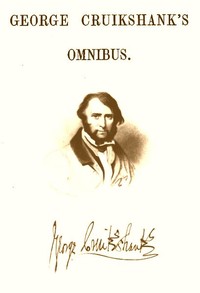
George Cruikshank's Omnibus opens with a Latin epigraph—"De Omnibus rebus et quibusdam aliis"—that signals its miscellany nature. The preface, titled "Our Preface," immediately establishes a self-aware, conversational tone, as the editor addresses readers directly, joking about the book's contents and the illustrator's prominence. This voice, at once learned and irreverent, sets the stage for a collection that veers between high-flown parody and low comedy.
The excerpts reveal a work built on abrupt transitions: a serious poem about an author's struggle is followed by a farcical orchestra brawl, and a mock-heroic tale of Hessian boots sits alongside a sentimental sketch. The narrative voice shifts from the editor's wry commentary to the exaggerated indignation of characters, creating a patchwork effect that mirrors the omnibus format itself.
The Editor's Playful Persona
The editorial voice in George Cruikshank's Omnibus is a character in its own right. Laman Blanchard, as editor, adopts a tone of mock-seriousness, introducing the collection with a Latin motto and then undercutting it with self-deprecating humor. In the preface, he refers to "My Portrait" and "My last pair of Hessian Boots" as if these trivial subjects deserve the same weight as the more substantial pieces that follow. This persona persists throughout: the editor interjects with "Omnibus Chat" sections, where he comments on the preceding content, often with a wry aside or a pun. The effect is that of a host guiding readers through a crowded room of curiosities, never letting them forget the artifice of the enterprise.
Sudden Shifts in Mood and Register
The collection's structure relies on jarring juxtapositions. A poem like "One of the Curiosities of Literature" describes a pale, tormented author writing a comic song—a moment of Gothic parody that is immediately followed by a mundane anecdote about picking up a passenger. Similarly, the tale of the double-bass player's revenge in the orchestra is told with deadpan detail, then capped by a moralizing remark from a friend. These shifts are not smoothed over; they are part of the design. The reader is expected to pivot from sentimental verse to broad farce without warning, a technique that keeps the pages turning but also highlights the artificiality of genre conventions. The editor seems to delight in confounding expectations, as when a serious passage about a suicide's grave is followed by a comic poem titled "The Grave of the Suicide (who thought better of it)."
Illustration as Narrative Engine
Though the text is the focus here, the excerpts repeatedly gesture toward George Cruikshank's illustrations. The table of contents lists engravings on steel and wood, and several pieces are clearly written around a visual conceit: "Photographic Phenomena; or, the New School of Portrait Painting" and "A Peep into a Leg-of-Beef Shop" suggest images that drive the prose. The editor's preface mentions "My Portrait" as the first item, implying that the book's humor often depends on the interplay between word and image. In the orchestra anecdote, the description of the double-bass player's "diabolical smile" and the violoncello player's fall is so vividly staged that it reads like a caption for a Cruikshank caricature. The text thus functions as a verbal complement to the illustrations, with the pacing and emphasis shaped by what might be depicted on the page.
Readers approaching George Cruikshank's Omnibus should expect a deliberately uneven ride. The editor's interventions and the rapid shifts in tone reward those who enjoy literary playfulness and period satire. Pay attention to the table of contents, which hints at the variety within, and note how the prose often mimics the exaggerated poses of Cruikshank's etchings. This is a book best sampled in short bursts, letting each curiosity stand on its own.
That rainy afternoon, Cruikshank’s unruly engravings kept pulling me sideways, away from the comic tales and into the margins, where the edges frayed into older, graver thoughts. Somewhere between a satirical verse and Marryat’s prose, I set the Omnibus down and reached for The works of Richard Hurd, volume 2 (of 8) — Text and Context, whose measured pages felt like finding a quiet room after loud company.

There are no reviews for this eBook.
How will you remember this book?
Save your reaction, strongest insight, and memorable passage.