
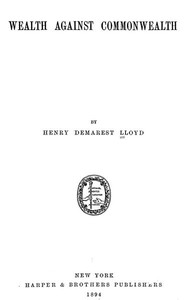
Wealth against commonwealth by Henry Demarest Lloyd
Forget the dusty, academic title for a second. 'Wealth Against Commonwealth' is a piece of detective work. Henry Demarest Lloyd, a journalist, spent years digging. His target? The Standard Oil Company and its mastermind, John D. Rockefeller. The book isn't a novel with a traditional plot, but the story it tells is gripping: how one company came to completely dominate American oil.
The Story
Lloyd lays out the case like a prosecutor. He details the 'secret rebates' Standard Oil got from railroads, which strangled smaller competitors who paid full price. He shows how they used industrial espionage, price wars in specific towns to ruin local businesses, and a web of confusing subsidiary companies to hide their control. This wasn't just smart business, Lloyd argues; it was a systematic campaign to eliminate free competition. He then traces the money from this economic power straight into the halls of government, showing how laws were shaped to protect the monopoly. The 'commonwealth'—the public good and the idea of a fair society—was being sold off piece by piece.
Why You Should Read It
This book hit me like a thunderclap. What's amazing is how current it feels. The specific tactics have changed, but the core conflict Lloyd identified—massive private power vs. public interest—is the story of our times. Reading his passionate, detailed accusations makes modern debates about tech giants, lobbying, and inequality feel like part of a much longer conversation. It gives you the origin story. You see the blueprint being drawn. Lloyd isn't a detached observer; he's angry and wants you to be angry too, to see the machinery behind the wealth.
Final Verdict
This is a must-read for anyone interested in the roots of American capitalism, politics, or social justice. It's perfect for readers who enjoy narrative nonfiction like 'The Jungle' or books that connect historical dots to the present. Be warned: it's dense with facts and figures—it's a crusade, not a beach read. But if you want to understand how the battle between corporate power and democracy began, start here. It's the original muckraking masterpiece, and its questions are still waiting for answers.
The copyright for this book has expired, making it public property. Access is open to everyone around the world.
William Davis
9 months agoMy first impression was quite positive because the formatting on mobile devices is surprisingly crisp and clear. Thanks for making such a high-quality version available.
Nancy Lopez
2 years agoI found the author's tone to be very professional yet accessible, the cross-referencing of different chapters makes it a great study tool. Highly recommended for those seeking credible information.
Paul Wilson
6 months agoI took detailed notes while reading through the chapters and the wealth of information provided exceeds the average market standard. This is a solid reference for both beginners and experts.
Mary Williams
6 months agoI started reading this with a critical mind, the critical analysis of current industry standards is very timely. It cleared up a lot of the confusion I had previously.


Joseph Smith
1 year agoI appreciate the objective tone and the evidence-based approach.