
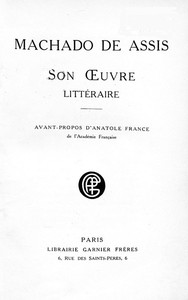
Machado de Assis, Son Oeuvre Littéraire by Lima, Machado de Assis, and Orban
Let's get this straight: 'Machado de Assis, Son Oeuvre Littéraire' is not a novel. You won't find the twisting plots of 'The Posthumous Memoirs of Brás Cubas' here. Instead, it's the story of a story. Written in French by the Belgian critic Victor Orban and published in 1909, just after Machado's death, this book was one of the very first serious attempts to introduce the Brazilian master to a European audience. Orban acts as both a guide and a detective, sifting through the scant details of a very private man's life to explain how his brilliant, ironic, and deeply human fiction came to be.
The Story
The book doesn't have a plot in the traditional sense. Its 'story' is Orban's journey of discovery. He starts with the basic, almost mythical facts: a boy from a poor, mixed-race background in Rio, with serious health issues, who taught himself French and rose to become the president of the Brazilian Academy of Letters. Orban then goes hunting. He looks at Machado's early poems, his work as a typesetter and journalist, and his gradual evolution into a novelist. The narrative is Orban connecting these dots, arguing that Machado's sharp wit and psychological insight weren't just talent, but tools forged by a life spent observing society from its edges. It’s a biography that feels active, like we're watching someone assemble a complex, fragile portrait from a box of old, scattered pieces.
Why You Should Read It
Here's the magic of this old critique: it reads like a fan letter from a very smart friend. Orban isn't a cold academic. His excitement is palpable. He’s genuinely thrilled by Machado's clever twists and wants you to be, too. Reading this, you get two for one: you learn about Machado's life and work, but you also get a window into how the world first started to recognize his genius. Orban’s perspective is fascinating—he’s explaining Brazilian culture to Europeans, which makes him point out things a local might take for granted. His analysis of characters like Bentinho and Capitu from 'Dom Casmurro' feels fresh, even now, because he’s seeing them with completely new eyes. It makes you want to go re-read Machado’s novels immediately, just to see if you can spot what Orban saw.
Final Verdict
This is a niche book, but a wonderful one. It's perfect for existing fans of Machado de Assis who want to go deeper and see his work through the lens of its first major international champion. It’s also great for readers interested in the history of literary criticism or how artistic reputations are built across continents. If you prefer fast-paced fiction, this might feel slow. But if you love the idea of literary archaeology—of watching a legacy being carefully unearthed and dusted off page by page—then Victor Orban’s passionate, century-old study is a unique and rewarding find.
This masterpiece is free from copyright limitations. It is available for public use and education.
Barbara Brown
9 months agoThe digital formatting makes it very easy to navigate.
Barbara Perez
6 months agoI've been looking for a reliable source on this topic, and the narrative arc keeps the reader engaged while delivering factual content. It’s hard to find this much value in a single source these days.
William Lopez
10 months agoThe layout is perfect for tablet and e-reader devices.
William White
1 year agoAs a long-time follower of this subject matter, the author clearly has a deep mastery of the subject matter. Top-tier content that deserves more recognition.




William Anderson
1 month agoIt took me a while to process the complex ideas here, but the step-by-step breakdown of the methodology is extremely helpful for students. I'm genuinely impressed by the quality of this digital edition.