
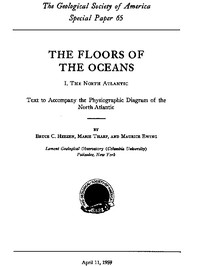
The Floors of the Ocean: 1. The North Atlantic by Heezen, Ewing, and Tharp
This isn't a traditional book with chapters and a plot. Instead, it's the collected work and story behind one of the most important maps ever made. In the late 1940s and 1950s, oceanography was a brand-new frontier. Scientists like Bruce Heezen and Maurice 'Doc' Ewing were sailing the North Atlantic, using newfangled sonar to 'ping' the seafloor and record its depth. They came back with boxes and boxes of data points: numbers on strips of paper.
The Story
Enter Marie Tharp, a geologist and cartographer hired to make sense of this mess. Barred from joining the voyages, her world was a drafting table in New York. Her job was to translate those lonely depth numbers into a visual landscape. As she plotted the points from successive ship tracks, a pattern emerged. The dots didn't scatter randomly; they hinted at steep valleys and towering ridges. Most shocking was a gigantic, V-shaped rift that ran like a scar down the center of the Atlantic basin. She was literally drawing a mountain range no human had ever seen. When she presented this rift valley to Heezen, he initially rejected it, thinking it was geologically nonsense. It took years of collecting more data before he was convinced she was right. Her map didn't just chart the bottom; it provided the key visual proof for the theory of continental drift, revolutionizing our understanding of how our planet works.
Why You Should Read It
What grabbed me was the sheer patience and vision required. Tharp worked for years before her 'Eureka!' moment was accepted. The book lets you see her process—the careful lines, the early drafts—and you feel the frustration and ultimate triumph. It's a powerful reminder that major breakthroughs often come from patiently connecting dots that everyone else sees as unrelated. It’s also a stark, unflinching look at the barriers women in science faced (and often still face). Her victory wasn't just over the unknown ocean, but over the doubt and institutional bias that tried to silence her discovery.
Final Verdict
Perfect for anyone who loves hidden histories, science stories that read like mysteries, or tales of quiet perseverance. If you enjoyed Hidden Figures, you'll find a similar spirit here. It's not a fast-paced adventure, but a slow, satisfying reveal of a world-changing truth pulled from the shadows. You'll never look at a map—or the ocean—the same way again.
No rights are reserved for this publication. Feel free to use it for personal or commercial purposes.
Joshua Anderson
1 year agoI was skeptical at first, but the plot twists are genuinely surprising. Worth every second.
Michael Thompson
1 year agoFinally found time to read this!
Jennifer Nguyen
1 year agoClear and concise.
Andrew Brown
1 year agoWow.


Jessica Moore
3 months agoWithout a doubt, it manages to explain difficult concepts in plain English. Thanks for sharing this review.