
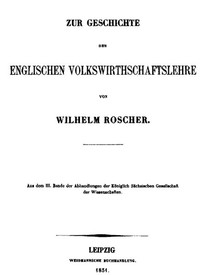
Zur Geschichte der englischen Volkswirthschaftslehre by Wilhelm Roscher
Let's be clear from the start: this is not a beach read. Wilhelm Roscher's Zur Geschichte der englischen Volkswirthschaftslehre is a serious, scholarly work from 1851. But if you have any curiosity about where our modern economic world came from, it's a fascinating deep dive.
The Story
There isn't a plot in the traditional sense. Instead, think of it as a guided tour through the attic of economic ideas. Roscher, a leading German economist of his day, takes us on a chronological walk from the Middle Ages up to the early 1800s. His goal is to show how English economic thinking evolved. He starts with the moral and religious views on trade from centuries ago, moves through the mercantilist period where building national wealth was everything, and finally arrives at the dawn of classical economics with thinkers like Adam Smith. He doesn't just list names and dates; he explains what each thinker believed, why they believed it, and how each idea built on or reacted against what came before. It's the story of an intellectual revolution, told step by step.
Why You Should Read It
Reading Roscher today feels like getting a masterclass from a different time. You see that our big debates—about free markets, government's role, the value of work—aren't new. They've been argued over for hundreds of years. What I love is Roscher's method. He treats economic ideas as living things that grow from their specific historical soil. He connects changes in thought to real events: the discovery of new lands, wars, and social upheavals. It reminds you that economics was never just math on a chalkboard; it was always about people trying to make sense of their changing world. You come away understanding that Adam Smith didn't appear out of thin air; he was the product of a long, messy conversation.
Final Verdict
This book is a specialist's treasure, but it has wider appeal for a very specific reader. It's perfect for history buffs, economics students, or anyone fascinated by the history of ideas. If you enjoyed books like The Wealth of Nations or Guns, Germs, and Steel and want to see the academic groundwork behind those big narratives, this is your next deep dive. Be warned: it requires patience. The prose is formal 19th-century German scholarship (even in translation), and it assumes some basic familiarity with historical periods. But if you're willing to meet it halfway, it offers a remarkably clear and comprehensive map of how England built the economic ideas that would eventually shape the globe.
This work has been identified as being free of known copyright restrictions. Thank you for supporting open literature.

Jackson Allen
1 year agoClear and concise.