About 46 minutes
A Discourse on the Evils of Dancing — Edition Insights
Historical Psychological Social Fiction
10,361 recorded words. 2 minutes difference from this book's estimate.
View Gutenberg source #36667
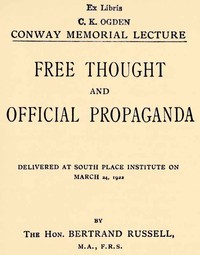
Free Thought and Official Propaganda — A Reader’s Guide can be approached with a clearer sense of reading commitment from its source measurements: 11,006 words, 48 min estimated reading time, and 2 detected text sections.
The text analysis averages about 23.9 words per sentence, while the detected sections provide another way to judge how the source is divided.
Project Gutenberg metadata also associates the work with “Free thought,” connecting these edition facts with the source record’s subject description.
Explore this collection
These alternatives are selected using recorded categories and estimated reading time.
About 46 minutes
Historical Psychological Social Fiction
10,361 recorded words. 2 minutes difference from this book's estimate.
View Gutenberg source #36667About 37 minutes
Historical Psychological Social Fiction
8,363 recorded words. 11 minutes difference from this book's estimate.
View Gutenberg source #30375About 25 minutes
Historical Psychological Social Fiction
5,548 recorded words. 23 minutes difference from this book's estimate.
View Gutenberg source #41063Search stored excerpts and compare books → Choose by your preferences →
Choices use stored catalog measurements. Estimates vary with reading speed. A shared category is a catalog label, not a claim that two books have the same argument or literary quality.
Search reads excerpt text stored with this catalog and links to its associated Gutenberg record. The connection is stored in the site database; this tool does not recheck that every excerpt is word-for-word identical to that external record. Excerpt search does not cover every chapter and does not verify historical publication dates.
Catalog snapshot checked: 2026-09-26. Coverage: 91 public books, 91 available source excerpts.
Calculated from edition completeness, EPUB availability, text structure and catalogue metadata. Not a user rating.
Total of 100 points, scaled to a 2.5-5.0 range. Editions with an empty description or a missing EPUB file are not scored.
Public-domain source text
The source text is kept in the dedicated reader, separate from this catalogue record and its commentary.
Bertrand Russell delivered this lecture at South Place Institute on March 24, 1922, with Professor Graham Wallas in the chair. The text opens with Wallas's introductory address, which immediately frames the problem: despite centuries of education, most people still reach conclusions shaped by their institutional background rather than by evidence. Wallas notes that ninety per cent of French or American students come to French or American conclusions, and eighty per cent of Eton boys hold Eton political opinions for life. This sets the stage for Russell's own analysis of how propaganda, economic pressure, and education systems work against free thought.
Graham Wallas's introductory address occupies the first portion of the text and establishes a key tension: education professes to teach thinking, but most people do not learn the difficult art of weighing evidence. Wallas describes the effective process as 'a sort of painful and watchful expectancy,' contrasting it with mere memorization or understanding. He observes that students shrink from the discomfort of questioning accustomed formulas, and argues that only by forcing vague premonitions into full consciousness can one arrive at new truths. This opening is not merely ceremonial; it previews Russell's later arguments about the irrational forces that shape belief.
Russell distinguishes two evils in propaganda: its appeal to irrational causes of belief, and the unfair advantage it gives to those who can afford publicity. He argues that the line between emotion and reason is not sharp, and that a clever person could frame rational arguments for any position. The real problem, he contends, is not merely emotional appeal but the inequality of resources. He illustrates this with a hypothetical: if two parties have equally good cases but one has a million pounds for propaganda and the other only a hundred thousand, the richer party wins. This inequality is intensified when one party is the government.
Russell devotes a section to economic pressure, which he sees as a growing danger. He notes that the government's monopoly on propaganda in Russia is an extreme case, but that even in democracies, the advantages of wealth and power are usually sufficient to give the ruling party victory unless it has an exceptionally bad case. He argues that equality of opportunity among opinions is essential for real freedom of thought, but that such equality would require elaborate laws unlikely to be enacted. The cure, he suggests, lies not primarily in legislation but in better education and a more sceptical public opinion.
Russell's lecture proceeds by identifying specific obstacles to free thought—propaganda, economic pressure, and education—and examining each in turn. His tone is analytical rather than polemical, and he frequently uses hypothetical examples to clarify his points. The text is structured as a sustained argument, with each section building on the previous one. Readers should note that the excerpts provided are incomplete; the full lecture likely includes additional sections and a conclusion. The existing text, however, already reveals Russell's characteristic clarity and his concern with the practical conditions of intellectual freedom.
This lecture offers a concise but penetrating analysis of the forces that constrain free thought in modern democracies. Russell does not propose easy solutions; instead, he diagnoses the problem with precision, distinguishing between the irrational appeal of propaganda and the deeper issue of unequal access to publicity. Readers approaching the text for the first time should pay attention to the interplay between Wallas's introductory remarks and Russell's own arguments, as well as the way Russell uses concrete examples to illustrate abstract principles.
I remember sitting in the university library in 1978, reading Russell’s lecture and feeling that familiar ache—how rarely we hear an opinion without a price tag attached. It reminded me of my grandmother’s worn copy of Leaves of Life, for Daily Inspiration — Edition Insights, which offered quiet space rather than answers, a different kind of freedom from doctrine. Both books, in their way, let me breathe.
Build a private reading journal entry for this title.