
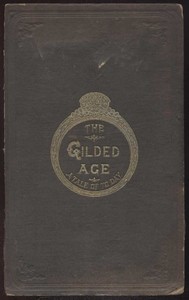
The Gilded Age, Part 7. by Mark Twain and Charles Dudley Warner
Let's set the scene: America after the Civil War is booming, or at least it looks like it is. Beneath a shiny surface of new money and big talk, there's a whole lot of scrambling, scheming, and cutting corners. This book throws us into the middle of that frenzy.
The Story
We follow two main paths that keep colliding. First, there's the idealistic but clueless Washington Hawkins, clinging to his family's claim to a huge tract of land in Tennessee. He teams up with the unforgettable Colonel Beriah Sellers, a man who can paint a vision of million-dollar fortunes from a patch of mud. Sellers' wild plans to sell the land and build a city—the 'Columbus River Slack-Water Navigation Company'—drive much of the action.
The second path follows the political machinations in Washington D.C., where Senator Dilworthy operates. Here, the game is about passing a bill to secure government funds for that dubious Tennessee land project. It's a swamp of lobbyists, bribes disguised as 'legal fees,' and hollow speeches about 'the public good.' The story smartly bounces between the naive hopes of the Hawkins clan and the cynical calculations in the capital, showing how the big dreams of little people are just pawns in a much richer man's game.
Why You Should Read It
What struck me most is how current it feels. Swap railroads for tech startups and land grants for government subsidies, and you've got a story about today. The characters are the best part. Colonel Sellers is a comic treasure—you almost want him to succeed with his insane plans because his enthusiasm is so infectious. But you also see the damage his pipe dreams cause. It’s a funny, sharp, and surprisingly sad look at the American obsession with get-rich-quick schemes. Twain and Warner aren't just mocking the corrupt senators; they're showing how our own willingness to believe in easy money makes the whole rotten system possible.
Final Verdict
Perfect for anyone who loves character-driven satire with real teeth. If you enjoy stories where the humor comes from painfully recognizable human flaws—greed, vanity, blind optimism—you'll love this. It’s also a great pick for readers who think classic literature has to be stuffy; this is anything but. You'll come away entertained, a bit wiser about human nature, and you'll never hear a too-good-to-be-true sales pitch the same way again.
The copyright for this book has expired, making it public property. Enjoy reading and sharing without restrictions.
Jennifer Martinez
10 months agoIt’s rare to find such a well-structured narrative nowadays, the transition between theoretical knowledge and practical application is seamless. I'm genuinely impressed by the quality of this digital edition.
Jennifer Jones
2 years agoI was skeptical about the depth of this book at first, but the historical context mentioned in the early chapters is quite enlightening. Highly recommended for those seeking credible information.
Mary Rodriguez
2 years agoA must-have for graduate-level students in this discipline.
Robert Gonzalez
7 months agoI was particularly interested in the case studies mentioned here, the narrative arc keeps the reader engaged while delivering factual content. It definitely lives up to the reputation of the publisher.





Kimberly Lopez
9 months agoUnlike many other resources I've purchased before, the emphasis on ethics and sustainability within the topic is commendable. I am looking forward to the author's next publication.