
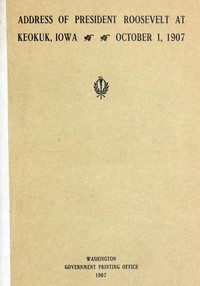
Address of President Roosevelt at Keokuk, Iowa, October 1, 1907 by Roosevelt
Let's be clear from the start: this isn't a novel. There's no plot twist on page 42. 'Address of President Roosevelt at Keokuk, Iowa' is exactly what it says on the tin—the full text of a campaign speech Teddy Roosevelt gave over a century ago. But calling it just a speech sells it short. It's a performance, a political battle cry, and a snapshot of a nation's growing pains, all wrapped into one.
The Story
The 'story' is the argument Roosevelt is making. He's on the road, stumping for his policies and his party's candidates. The central issue is government regulation of big business, especially railroads. Roosevelt believes massive corporations and powerful trusts have gotten too big, charging unfair rates and stifling competition. He argues the government must have the power to control them to protect farmers, small business owners, and regular folks. He walks his audience through specific laws he's championed, like the Hepburn Act, and defends his actions against critics who call him a radical. The narrative arc is his effort to convince the people of Iowa that a strong, active federal government is essential for a fair economy.
Why You Should Read It
You should read it because it crackles with a personality we rarely see in politics today. Roosevelt's voice is unmistakable—confident, direct, and brimming with conviction. He doesn't speak in careful, poll-tested soundbites. He calls his opponents' arguments 'silly' and states his case with bold simplicity. Reading this, you understand his magnetic appeal. The themes are timeless: the balance between corporate power and public good, the role of government, and what 'fair play' means for a country. It's a masterclass in persuasive rhetoric aimed straight at the heart of Middle America.
Final Verdict
This is a perfect pick for history buffs who want to go beyond textbooks and hear a president's words raw and uncut. It's also great for anyone interested in politics, rhetoric, or the roots of America's ongoing debates about business and government. Because it's a single speech, it's a quick, focused read—you can finish it in one sitting. Don't expect a balanced documentary; expect to ride the train with Teddy, feel the crowd's energy, and get a potent dose of his 'Square Deal' philosophy straight from the source. It's a small book with a very big voice.
This is a copyright-free edition. You are welcome to share this with anyone.
Mary Davis
9 months agoUnlike many other resources I've purchased before, the argument presented in the middle section is particularly compelling. A solid investment for anyone's personal development.
Christopher Thomas
8 months agoI particularly value the technical accuracy maintained throughout.
Richard Lopez
11 months agoI appreciate how this edition approaches the core problem, the breakdown of complex theories into digestible segments is masterfully done. A refreshing and intellectually stimulating read.
Emma Jones
2 years agoThis book was worth my time since the flow of the text seems very fluid. Definitely a 5-star read.

Robert Harris
5 months agoGiven the current trends in this field, the level of detail in the second half of the book is truly impressive. Well worth the time invested in reading it.